

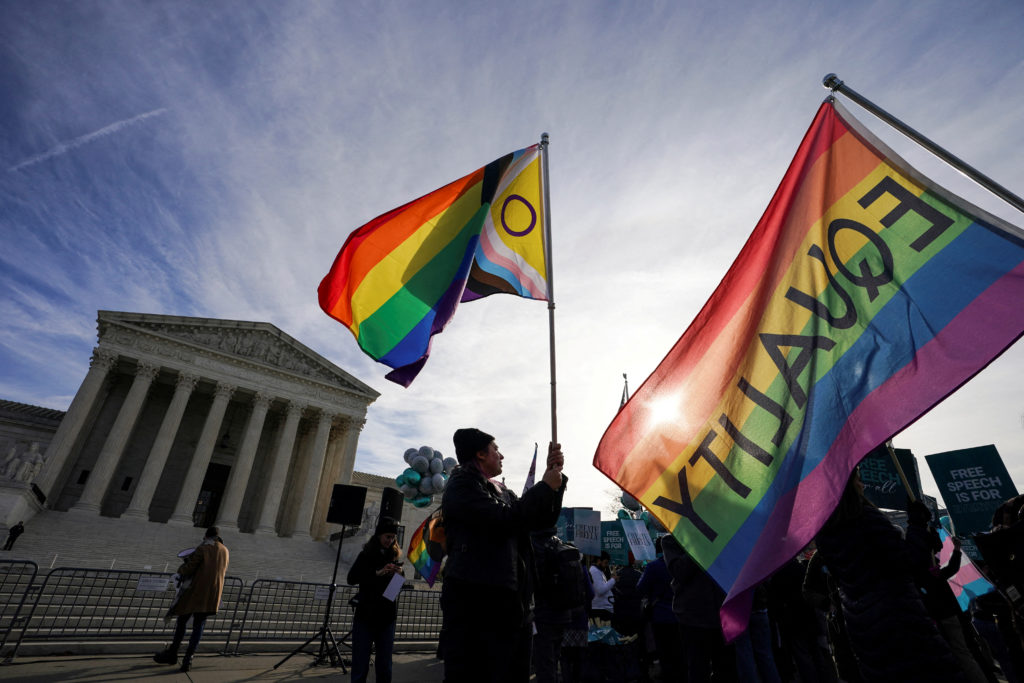
On October 7, 2025, the Supreme Court heard Chiles vs Salazar, a case on a 2019 Colorado law that bars mental health professionals from offering minors treatment that purports to change their sexual orientation or gender identity. Chiles a christian therapist argues that her practice is being infringed upon by this law. Colorado argues that Chiles’ therapy should be restricted based on the 2019 law.
Conversion therapy is a practice dating back to the late 1800s. It is attempting to change an individual’s sexual or romantic orientation to align with heterosexual or cisgender norms. In the 1920’s psychology became more prevalent with the introduction of psychoanalysis, a practice developed by Sigmund Freud. Freud claimed that homosexuality could sometimes be removed by hypnotic suggestion. He has also expressed his belief that homosexuality is nothing to be ashamed of and that it cannot be classified as an illness. The American Psychiatric Association (APA) categorized homosexuality as a mental disorder until 1973, after pressure from gay activists and disputes among psychiatrists. The American Medical Association, as well as the APA, both condemn the practice of this kind of therapy. As well as 20 states, DC, Puerto Rico, and 100+ municipalities have also condemned such a practice.
Chiles’s lawyer argues that the law could be used to silence medical therapists such as Chiles, especially for the treatment of state-disfavored goals on issues of sexuality and gender. The minor courts ruled that the law only regulates conduct and only incidentally effects the treatment given by Chilles. The court of appeals, after reviewing the case, argued that the Supreme Court should review the case for constitutional challenges.
The Supreme Court, during the review of this case, gave some varying opinions on the case. Justice Ketanji Jackson argues the long historical tradition of regulating medical practices, and finds it odd that two different medical professionals would have two different treatments for the same condition. Treatment could be speech therapy or medication, but the two treatments are regulated differently. Justice Alito challenged this opinion, calling the opinion “blatant viewpoint discrimination,” arguing that the law discriminated against Chilles’ beliefs. At the end of the arguments, the court suggested the case get sent down to lower courts to argue if the Supreme Court decided the law discriminated against Chilles, then should the Supreme Court or a lower court apply strict scrutiny on the law.
In the middle of her arguments, Justice Brown questioned the courts lack of equivalence in rulings made. She noted the ruling on a Tennessee ban for gender affirming care for minors being upheld, comparing it to the Colorado law. She noted that “both regulations work in basically the same way” and said, “ I’m just, from a very broad perspective, concerned,”.
A ruling is expected summer of 2026 after the lower courts rule on the viability of the Supreme Court to enact changes to the law. The justices do not vary from their own political alliances. The conservative justices will argue that Chilles is being discriminated against for her beliefs, while the liberal justices, like Jackson, will argue at the standard care of practice for treatment.
